
No, we all know that is false because Ireland has repeatedly been named one of the safest countries in the world for pregnant women. The same cannot be said for countries with liberal abortion laws.
In fact, in 2009 the BBC reported that a UNICEF report put Ireland as the safest place to have a baby in the world, and the maternal mortality rate is one of the lowest globally.
Here is an idea of how safe Ireland is for pregnant in comparison to other countries which have legalised abortions:
-

India – Maternal Mortality Rate is 33x higher than in Ireland
-
Britain – Maternal Mortality Rate is 2x higher than in Ireland
-
United States – Maternal Mortality Rate is 3.5x higher than in Ireland 1
This argument, that women aren’t safe in Ireland without abortions, broke out again on the radio, as well as print, when the Pro-Life Campaign’s Cora Sherlock claimed Ireland had a ‘phenomenal record’ on maternal health, up to the introduction of the Protection of Life During Pregnancy Act in 2013.
Ms Sherlock’s words aired on Morning Ireland, and her full statement was:
“Ireland…had a phenomenal record in protecting women’s health and protecting maternal health, right up to 2013, when abortion was introduced in this country…”
You can listen to her interview here.
In retort to her comment, the Irish Times’s Fintan O’Toole said her claim was “based on figures that have long since been shown to be ludicrous”.
He is among several repeal the 8th activists who believe that pregnant women are in danger in Ireland due to the restricted access to abortion.
To help uncover the truth, the Journal published a Factcheck story which put Cora’s words under scrutiny to see if there was any merit in them. As the evidence below shows, Ms. Sherlock’s words were truthful.
Here is the link to the Factcheck story.
Evidence
The Journal’s story right of the bat shows Sherlock’s statement to be mostly true and here is their evidence.
To begin, the Journal makes sure to note that the statistics referred to are that of maternal mortality rates, as that was the basis of Sherlock and O’Toole’s comments, as opposed to statistics of women’s maternal health in general.
When asked where Cora got her statistics showing the “phenomenal record” of Ireland’s maternal health, she cited: “figures from the Confidential Maternal Death Enquiry, as well as a major 2015 report put together by the World Health Organisation (WHO), World Bank, UNICEF and the UN Population Fund.”
When these sources were checked by Factcheck they found little to suggest that Cora had lied in her statement.
“FactCheck gathered the most up-to-date, comprehensive data available, covering the period of 1985 to 2015, from the World Health Organisation report also cited by Cora Sherlock.”
The WHO reported on the maternal mortality rate, which is explained below:
- The maternal mortality rate (MMR) is the number of maternal deaths for every 100,000 live births in a country in a given year.
- The WHO defines a maternal death as: “The death of a woman while pregnant or within 42 days of termination of pregnancy…from any cause related to or aggravated by the pregnancy or its management (from direct or indirect obstetric death), but not from accidental or incidental causes.”
With the MMR and the definition of maternal death now explained, we now refer to the results of the WHO’s report as cited in Factcheck.
The Results
For the past 30 years, Ireland has been among the leading nations with the lowest MMR. Out of 183 countries considered in the WHO’s report the countries with liberal abortion laws had and still have higher maternal mortality rates, whereas Ireland’s MMR has been a consistent 6%, and only rarely rising or dropping as indicated in the graph below.
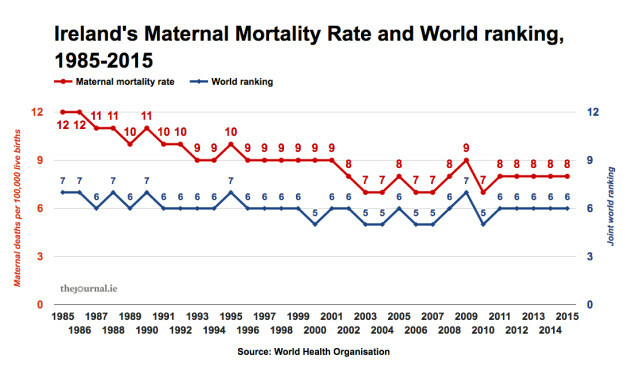
The reason for such a low number of maternal deaths is not necessarily due to the strict availability of abortions in Ireland, though it could play a part.
“Malta, the only other European country with an abortion regime roughly as restrictive as Ireland’s, had an average MMR of 13, the same as Singapore, which has a relatively quite liberal abortion regime.”
In light of this statement, referring to availability of abortion and maternal deaths, Cora Sherlock replies:
“…I am not suggesting the non-availability of abortion in Ireland is in itself the reason we have a better record but rather that the availability of abortion doesn’t make a country any safer in protecting the lives of women.”
But why “Without abortion…up to 2013”?
Factcheck reports that data for Ireland’s low MMR did not change with the introduction of the Protection of Life During Pregnancy Act 2013, so why did Sherlock emphasise “up to 2013”?
When asked, Cora Sherlock clarified by stating that she had “phrased the claim in this way to emphasise that Ireland’s maternal mortality record was, in her words, ‘phenomenal’ before and without the introduction of abortion in 2013.”
Factcheck believes that this further reinforced her statement: “the availability of abortion doesn’t make a country any safer in protecting the lives of women”.
Sherlock wanted to make it clear that there had been no suggestions by her that the statistics on maternal deaths had changed after 2013.
Factcheck ends with this comment: “to be clear: Ireland, with and without abortion, before and after 2013, has had and continues to have, an extremely high standard in its record on maternal deaths.”2
The facts are clear, Ireland is a safe place for pregnant women. A repeal of the 8th Amendment could change that.
1 http://apps.who.int/iris/bitstream/10665/44874/1/9789241503631_eng.pdf
2http://www.thejournal.ie/maternal-deaths-mortality-rate-ireland-pro-life-campaign-statistics-2921139-Aug2016/
 IT'S TIME TO RESPECT