
Nope – This is extremely incorrect because there is no such thing as the right to abortion anywhere in international law. There is, however, the right to life which holds primacy over all other human rights; let’s examine. 
The right to life of every human person from conception to natural death lies at the foundation of all authentic human rights. There is no such thing as right to abortion anywhere in international law. On the contrary, all UN foundational documents uphold the dignity of every human life, no matter how young or old.
The Universal Bill of Human Rights consists of the Universal Declaration of Human Rights 1948 (UDHR), the International Covenant on Civil and Political Rights 1966 (ICCPR), the International Covenant on Economic, Social and Cultural Rights 1976 (ICESCR) and their optional protocols. The UDHR has served as the foundation for a number of national and international laws protecting and promoting human rights. The Declaration is founded upon the notion that there are authentic human values and these values are vested in every human individual, because of their “inherent dignity”.
In the Preamble of the Declaration it is stated that “the foundation of freedom, justice and peace in the world” is the “recognition of the inherent dignity and of the equal and inalienable rights of all members of the human family”.
Further, the Preamble links human dignity, human values with human rights that it describes as “inalienable rights”, rights of which we may not be deprived and cannot deprive ourselves. These human rights which reflect human values must, says the Preamble, “be protected by the rule of law” otherwise humankind may be driven, “as a last resort, to rebellion against tyranny and oppression”.
Universal right to life
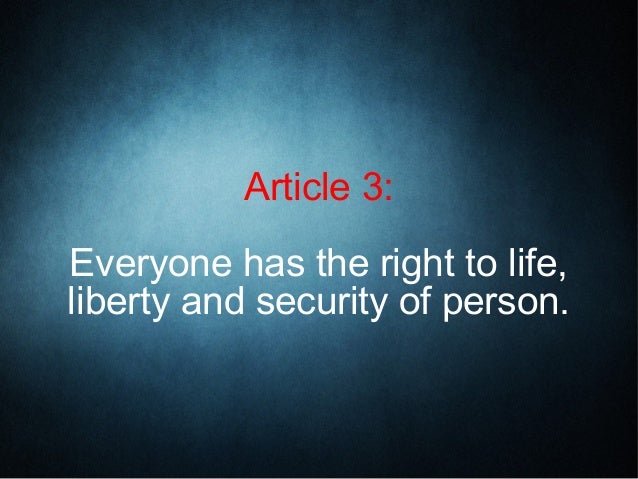
As is written in many locations, human life is held to be both inviolable and inalienable. Noting the order of the rights articulated is also important – life first, then freedom [liberty], and then security of person. Unless the State can guarantee the right to life then there are no meaningful rights to freedom or to security of person. The right to life is logically prior to considerations of the quality of the individual’s life.
The question of whether UN documents were written with the intention of protecting all human life from the moment of conception is hotly debated and attempts to interpret them in the light of anti life ideology have increased.
The answer to this question, however, is clear from the Declaration on the Rights of the Child (1959) that sets out the Parameters, quoting the UN Charter, the Universal Declaration of Human Rights and the Declaration of Geneva (1924):
- WHEREAS the United Nations has, in the Universal Declaration of Human Rights, proclaimed that everyone is entitled to all the rights and freedoms set forth therein, without distinction of any kind, such as race, colour, sex, language, religion, political or other opinion, national or social origin, property, birth or other status,
- WHEREAS the child, by reason of his physical and mental immaturity, needs special safeguards and care, including appropriate legal protection, before as well as after birth,
- WHEREAS the need for such special safeguards has been stated in the Geneva Declaration of the Rights of the Child of 1924, and recognized in the Universal Declaration of Human Rights and in the statutes of specialized agencies and international organizations concerned with the welfare of children,
The preambular paragraphs of this declaration made in 1959 thus claim that the right to life is protected before as well as after birth and that the need for special safeguards to secure this right has actually been recognized in the Universal Declaration of Human Rights.
The human rights of children in the womb are being unjustly denied.

Rights of the Child
The Convention on the Rights of the Child was specifically written to protect every human being from conception onward. Unfortunately, there is a lot of misinformation on this subject. It is not unusual to hear such claims as, “The Working Group made a compromise that allowed each State to do decide for itself the meaning of ‘human being’ in Article 1” or, “The CRC does not apply prior to birth.” Those statements are untrue.
The Right to Health, in Article 24, expressly gives children rights during the entire pre-natal period:
- States Parties recognize the right of the child to the enjoyment of the highest attainable standard of health…
- States Parties shall pursue full implementation of this right, in particular, shall take appropriate measures: […] (d) To ensure appropriate pre-natal … health care for mothers. (Article 24; italics added.)
Pre-natal care therefore is given for the benefit of both the child and the mother, and the well-being of each is tied to the well-being of the other. The two beneficiaries of healthcare are recognised in the 1959 UN Declaration on the Rights of the Child:
The child … shall be entitled to grow and develop in health; to this end, special care and protection shall be provided both to him and to his mother, including, adequate pre-natal and post-natal care. (Principle Four).
Interpretation and inconsistency
Children need special protection and care during the entire pre-natal period — as stated in the Declaration, and as universally recognized in the life-cycle understanding of our existence –, and they need legal protection during this period to help ensure they receive the special care. This gives unborn children legal protection under international law. The interpretation that excludes them produces an inconsistency between the different parts of the Declaration, so it must be rejected.
While the text of this and other conventions are clear, various UN Committees have, however, set about expansion and/or reinterpretation of convention texts by issuing General Comments that are reviewed with certain intervals.
Right to Abortion
This past July, the United Nations Human Rights Committee published a document called General Comment No. 36 which sought to reinterpret the International Covenant on Civil and Political Rights (ICCPR). This Committee argued that the ICCPR should declare that states “must” provide access to abortion.
However, nowhere in that document is abortion ever mentioned. On contrary, the treaty explicitly recognises in Article 6(1) that: “Every human being has the inherent right to life.”[1]
Further, Article 2 of the Covenant declares that this right should be respected “without distinction of any kind” including by “birth or other status.”[2] Article 7 prohibits anyone to be subjected to “torture or to cruel, inhuman or degrading treatment or punishment.” Abortion procedures crush, poison, or dismember the unborn child, many of which are able to feel pain, and clearly constitute the most cruel, inhumane, and degrading treatment imaginable. It seems quite clear that the ICCPR actually prohibits abortions if it is interpreted literally. Another reason why there can be no right to abortion, especially in international declarations. Read here to find out more.
Let’s assess further why there is no right to abortion. Despite the clear international law upholding the right to life, in some jurisdictions, such as the UK, the woman’s right to bodily autonomy has trumped the right to life of all humans, including the unborn. The so-called right to abortion has been interpreted from the various declarations on human rights. However, if you look at the definition of what a human right is, then there is no indication whatsoever of a right to abortion, instead there is only the equal right to life of everyone.
According to the United Nations Human Rights Office of the High Commissioner: “Human rights are rights inherent to all human beings, whatever our nationality, place of residence, sex, national or ethnic origin, colour, religion, language, or any other status. We are all equally entitled to our human rights without discrimination. These rights are all interrelated, interdependent and indivisible.”3 Because there is no right to abortion, what exactly do repeal the 8th activist argue for when they say their human rights are being violated?
Here are some of the common arguments by repealers:
- Pro-choice advocates, the Irish Family Planning Association, argue:
“Access to safe and legal abortion is a human rights issue. By criminalising abortion in almost all circumstances, Ireland’s abortion laws deny women and girls their most fundamental rights to health, to live in dignity, to self-determination, and to access these rights without discrimination.”4
-The truth: It should be argued that there is nothing certain about any medical procedure and at the very least one that’s sole purpose is to destroy life. When it comes to denying fundamental rights, the repeal the 8th advocates are right, but not about whose rights are being denied. All human rights are possible only after the right to life, without life you cannot have any other rights. Which is why the right to life must be protected and put above all other rights such as the right to self-determination.
- The online pro-choice webpage and infamous abortion pill provider, Woman on Web, testify:
“The right to safe abortion, to determine when and if to become a parent, and the right to healthy sexuality is an issue of both human rights and of social justice. Induced abortion is one of the most commonly performed medical interventions. Making abortion illegal does not reduce the number of abortions. Access to safe abortion and legalization of abortion can prevent unnecessary suffering and death of women.”5
-The truth: There is no justice in killing innocent unborn babies, regardless of how they were conceived. By denying the right to life of the unborn because someone is not ready to become a parent is a weak excuse to abort that child. As far as the right to healthy sexuality, that right does not extend to when another human’s rights are at stake. The right to healthy sexuality and deciding when to become a parent should be exercised before conception, not when a child is already on the way, and both of these rights cannot come before the right to life.
-
The Irish Family Planning Association also states:
“This approach is consistent with the key human rights standard of proportionality, which requires that laws and policies applied to regulate access to abortion cannot excessively interfere with women’s human rights – including the right to life, health, privacy, freedom from cruel and in humane treatment and non-discrimination.”6
-The truth: What is more cruel and in humane than dismembering an unborn babies limbs from their body and throwing them away as if they were just a parasite? There is little that comes close to this sort of brutality to another human being, and nothing that comes close enough to justify an abortion. Quite frankly laws that regulate legal abortions are not consistent with the right to life, and society is failing those who believe that abortions are protecting human life.
All in all, the right to life of all human beings should always stand before other human rights as one blogger reveals:
“We’re not interested in getting into people’s bedrooms and telling them how to have sex and how to live. We’re not interested in restricting choices because we are bigoted and want to make people’s lives miserable. We’re interested in human rights.”7
You can read more about human rights and the right to life here as well as here.
[1]https://www.pop.org/pri-civil-society-denounce-u-n-committee-attempt-create-abortion-rights/#_ftn1
[2] https://www.pop.org/pri-civil-society-denounce-u-n-committee-attempt-create-abortion-rights/#_ftn10
3http://www.ohchr.org/EN/Issues/Pages/WhatareHumanRights.aspx
4https://www.ifpa.ie/Hot-Topics/Abortion/Abortion-and-Human-Rights
5https://www.womenonweb.org/en/page/508/abortion-a-matter-of-human-rights-and-social-justice
6https://www.ifpa.ie/Hot-Topics/Abortion/Abortion-and-Human-Rights
7https://www.str.org/articles/abortion-human-rights#.WV9pIYTyvhk
 IT'S TIME TO RESPECT