
No, this is sadly just another lie on behalf of the Repeal lobby. Around 90% of babies diagnosed with Down’s Syndrome in England and Wales are aborted, as the facts below show.
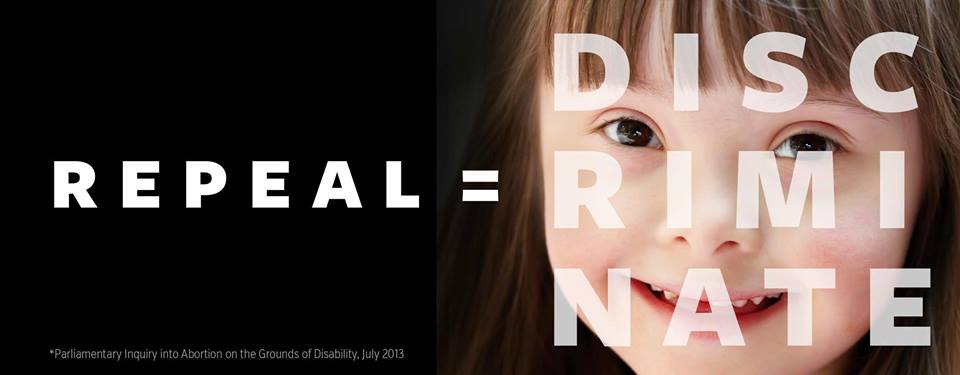
A common misconception the Repeal the 8th movement may argue, is that unborn babies found to have Down’s Syndrome are not being targeted through the availability of abortions. However, given recent developments in the UK and other European countries such as Denmark, this is not the case.
Why do so many people deny the truth that babies are being aborted because they have Down’s Syndrome? One possible answer is because there are too many “facts” circulating around this debate and no one knows which facts are actually true.
Such a debate aired on Tonight with Vincent Browne in June 2016. A number of facts regarding the percentage of abortions carried out on babies diagnosed with Down’s Syndrome were thrown at opposing sides leaving no clear indication to what was actually true. Following the debate between the Pro-Life Campaign’s Cora Sherlock and AAA/PBP TD Ruth Coppinger, the Journal fact checked the authenticity of each speaker’s facts and the results favour Cora’s facts as the most truthful.
Here are the statements that were made by each spokeswoman cited from The Journal’s article:
Cora Sherlock’s claim:
In England at the moment, 90% of babies diagnosed with Down syndrome are aborted.
Ruth Coppinger’s claim:
There are some statistics that were done in England and Wales from 2008-2012, and they showed 44% of pregnancies that got a pre-natal Down’s diagnosis were born.
The following are direct segments from the Journal’s article outlining the sources for each spokeswoman’s argument:
“We asked Cora Sherlock for a source for her claim. She cited this 2013 UK Parlimentary Inquiry report on abortion on the grounds of disability.
The relevant figures there were in turn taken from the National Down Syndrome Cytogenic Register (NDSCR) for England and Wales, Annual Report 2010.
The figures are for England and Wales, not just England as Sherlock said on Tonight with Vincent Browne
The report found 1,188 pre-birth Down Syndrome diagnoses in 2010
79% (942) ended in termination; 4.5% (54) ended in live birth; 2% (25) ended in foetal death; the outcome was unknown in 14% of cases (167)
Of the cases whose outcome was known, 92% ended in termination.
But those figures are old. The most recent NDSCR report was for 2013. It found:
1,232 pre-birth Down Syndrome diagnoses in 2013
75% (925) ended in termination; 6.7% (82) ended in live birth; 1.6% (20) ended in foetal death; the outcome was unknown in 16.6% of cases (205)
Of the cases whose outcome was known, 90% ended in termination.“
How then do the Repeal the 8th Amendment movement muddle their facts? As the Factcheck article provides, the facts, as presented by pro-choice advocate Ms. Coppinger, did not take in the whole picture, leaving an incomplete view of the truth. The Journal reports:
“We asked Ruth Coppinger for a source for her claim, and she cited data from EUROCAT – a European network of registries for the “surveillance of congenital anomalies”.
The figures she supplied related to England, Ireland, Wales and Glasgow, and not just England and Wales, as she stated on Tonight with Vincent Browne.
We ran the numbers ourselves, and here’s what we found:
From 2008 to 2012, there were 3,836 Down Syndrome diagnoses in those areas
46.6%(1,788) ended in termination after a pre-natal diagnosis; 49% (1,887) ended in live birth; 4.2% (161) ended in foetal death.”
Thus the Factcheck concludes as follows:
“Both Coppinger and Sherlock misstated their own claims on Tonight with Vincent Browne.
Sherlock said “England”, when the data she was citing actually related to “England and Wales”, and did not specify she was talking about pre-birth diagnoses.
However, allowing for that as a simple misstatement, the 90% figure she presented was largely accurate, and her claim is Mostly TRUE.”
The conclusion for the repeal campaigner, Coppinger, unfortunately did not have that outcome. Factcheck found:
“Coppinger said “England and Wales”, when the data she was citing actually related to England, Wales, Glasgow and Ireland.
This can also fairly be put down as a simple misstatement.
However, she presented terminations as a percentage of all diagnoses, as terminations as a percentage of pre-birth diagnoses.
This massively skews the data, and gives us a rate of 54.8%, where (as we calculated above) 84% is more likely to be accurate.
Her stated claim was that 44% of pre-birth Down Syndrome diagnoses end in live birth, but we know this cannot be true, if around 84% ended in termination.
However, there is no absolutely definitive source for this statistic, and studies vary somewhat by method and geography.
For this reason, her claim is Mostly FALSE.”
To read the full Factcheck article click here.
Why are babies with Down’s Syndrome being discriminated against?
Having now established that babies with Down’s Syndrome are being exterminated, we need to look at why and how wrong it is to terminate them.
A blog written by the Netherland’s Downpride spokeswoman Renate Lindeman has outlined the main concerns facing those with Down’s Syndrome children today. What seems to be a major problem leading to the negative outlook on people with this disability is society seeing people with Down’s Syndrome as costly burdens and as people with “avoidable human suffering”. These are reasons for terminating a pregnancy?
Have societies accepted that they do not need Down syndrome people because they cannot contribute to our society? So if a woman finds out, through a pregnancy screening, that her child has Down’s Syndrome she has the choice to end the baby’s life because it is too much of a burden for that child and/or the parents? This is what is proposed by providing for abortion is whatever circumstances a woman sees fit. How is this not considered exterminating people with Down’s Syndrome?
Let’s look at more facts that show that it is the case that the unborn children who screen positive for Down’s Syndrome, are being targeted through abortions:
In 2006, Denmark issued a public-health-care programme commencing routine screening for Down’s Syndrome. Following Denmark’s lead, France, Switzerland and other European countries did the same. An article by Copenhagen Post published in 2011, stated that Denmark “could be a country without a single citizen with Down syndrome in the not too distant future.” 1 This statement follows the proven fact that babies with Down’s Syndrome are being exterminated through abortion, so it is no surprise that they may become extinct in some countries.
Should people with disabilities be considered a burden given modern medical and social advances on what it means to live with Down’s Syndrome? As Renate Lindeman, a woman with two Down’s Syndrome children says:
“Most people with Down’s Syndrome are included in schools and communities. They live healthier, longer lives, and many adults live independently, have jobs and enjoy a rich social life. In 2013, a young woman with Down’s Syndrome became Spain’s first councilor. One study showed that the majority of people with Down’s Syndrome report being happy and fulfilled, regardless of their functional skills.”2
So we ask again, how can it be argued by the Repeal movement that unborn Down’s Syndrome babies should be terminated because they cannot live a happy life because they are too busy being a burden? The problem is not the person with Down’s Syndrome, the problem is the way in which society puts little to no value on their lives. Particularly the pro-choice movement in several jurisdictions who allow for this extermination to occur.
A test may show that your baby has Down’s Syndrome; society may tell you that they are not going to have a meaningful life and will only be a burden; those who campaign for a woman’s right to choose and access abortion want women to have the choice to terminate the life of their Down’s Syndrome baby; but the truth will show you that people with Down’s Syndrome have worth, regardless if it can be measured on a societal scale. Ending the life of an unborn baby for their condition does not lead to an inclusive society or a society that celebrates diversity.
As Renate Lindeman says, “If we allow our governments to set up health programs that result in the systematic elimination of a group of people quite happy being themselves, under the false pretense of women’s rights, than that is a personal choice.”3
Repeal in Ireland means the discrimination of people who are happy being themselves. Repeal in Ireland does not create country where all women are free. Repeal in Ireland could lead to a Down’s Syndrome free state within a few decades. This is not a step in the direction of a society that accepts all its members.
2https://www.washingtonpost.com/posteverything/wp/2015/06/16/down-syndrome-screening-isnt-about-public-health-its-about-eliminating-a-group-of-people/?utm_term=.ffa08a0aafc3
3Ibid
 IT'S TIME TO RESPECT